
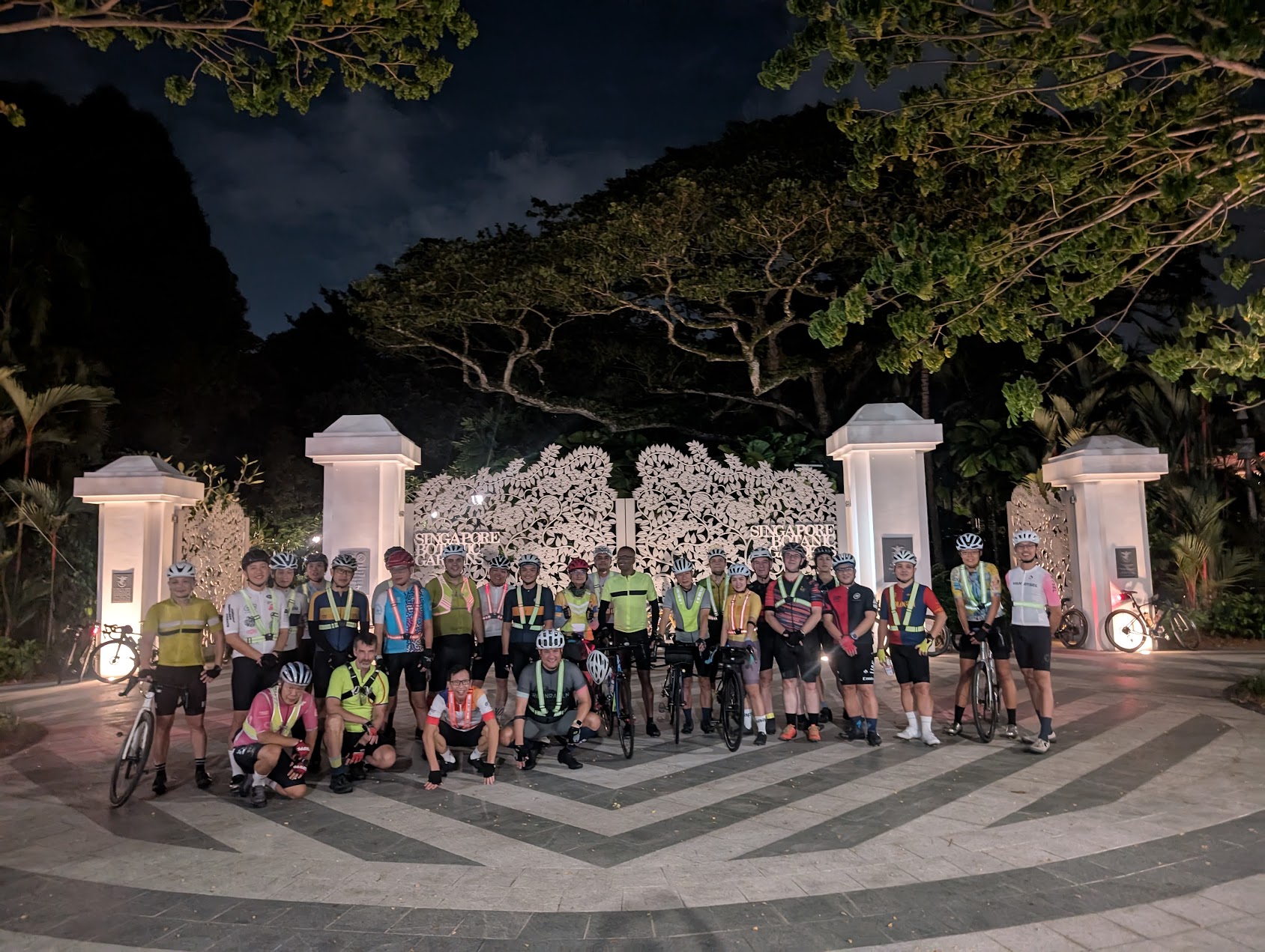
01 — Start & grace window
Every RSG brevet has one designated official start point and one published official start time. Riders should arrive early enough to complete sign-in, collect any required brevet card and receive event updates.
30-minute grace window. A registered rider may start up to 30 minutes late from the official start point. The brevet clock still begins at the published start time and no additional completion time is granted. More than 30 minutes late is recorded as DNS.
02 — Time limits
BRMs must be completed within the applicable overall time limit and any control requirements stated for the event. Starting late does not move the closing time.
Standard limits: BRM200KM — 13.5 hours · BRM300KM — 20 hours · BRM400KM — 27 hours · BRM600KM — 40 hours.
03 — Route & controls
After starting, riders must complete the full brevet route under their own power and comply with the official route and control requirements. If you leave the route for food, rest, repairs or another personal need, return to the point where you left it before continuing.
Always use the route and control instructions published for the specific event.
04 — Proof of passage
Riders are responsible for collecting the evidence required at each control. RSG events may use a combination of brevet card entries, photographs and recorded activity data. The event brief specifies what is required.
Missing or inadequate evidence can prevent validation even when the physical distance has been ridden.
05 — Night riding & visibility
Front and rear lights must be used when conditions require them. During RSG night riding, the required reflective vest or garment must be worn as the outermost layer so that its reflective material remains visible.
Riders are responsible for keeping their lighting functional throughout the event and should carry an appropriate backup or charging strategy.
06 — Riding in Malaysia
On Malaysian roads, RSG riders are expected to ride single file unless road conditions or an event instruction specifically require otherwise. Observe local traffic law, make your movements predictable and do not allow a group to obstruct other road users.
The event brief may contain border, immigration, route or local-safety instructions specific to that brevet.
07 — Mechanical problems & outside support
Ordinary repairs, food and rest are part of self-supported randonneuring. A rider who leaves the route must return to the same point before continuing.
Where an essential mechanical failure makes reaching a repair facility by bicycle or on foot impractical or unsafe, the organiser must be informed as soon as reasonably possible. Any permitted repair transport must not advance the rider along the brevet route; the rider must return to the exact interruption point before resuming.
Event-specific or ACP rules may impose additional conditions. When uncertain during an event, contact the organiser.
08 — DNF & withdrawal
If you decide to stop riding, notify the organiser as soon as reasonably possible. Once withdrawn, do not continue presenting yourself as an active brevet participant or expect event controls to account for your progress.
Your safe onward transport after withdrawal remains your responsibility unless the event brief explicitly provides otherwise.
09 — Rider conduct
Riders must obey traffic law and behave responsibly toward other road users, volunteers, businesses hosting controls and fellow riders. Registration in a brevet does not give priority over public roads or private premises.
Unsafe, abusive or deliberately disruptive conduct may result in the organiser taking action under the applicable event or participation rules.
10 — Finish & result submission
Finishing the route does not by itself complete the validation process. Follow the event instructions for submitting the brevet card, photographs, activity recording and any other required evidence.
RSG checks the submission before a result is confirmed and, for homologated events, processed through the applicable ACP validation process.